1.9%
of adults in England screened positive for bipolar disorder, an estimated 890,000 people. Statistically unchanged since 2014.
NHS England · Adult Psychiatric Morbidity Survey 2023/24

How the pendulum swings
On the swings a whole country chooses every Saturday, the swings some people cannot switch off, and the distance between the two. With every figure sourced.
Turner · 1842
From the Editor
There is a moment at the end of a football match that nobody thinks about, because it is the least dramatic thing that happens all afternoon. A man in the middle raises a whistle to his mouth and blows it, and tens of thousands of people stop feeling what they have been feeling.
That is the subject of this issue. Not the feeling. The stopping.
Every weekend from August to May this country runs the largest voluntary experiment in collective mood alteration available to a nation at peace. Enormous numbers of people agree, in advance and at their own expense, to feel considerably more than the occasion strictly requires. They agree to have their heart rate driven up by the movements of strangers. They agree to grieve over events with no bearing whatsoever on their lives. It is one of the more peculiar things we do, and we do it so routinely that it has stopped looking peculiar.
Then the whistle goes, and it ends, and everybody puts their coat back on and thinks about the car park.
Now remove the whistle. Remove the choice. Remove the fifty thousand other people riding the same arc at the same instant. What is left is not football, and it is not a bad mood. It is a different category of thing entirely, and this issue is about how poorly that difference is understood by people who have only ever known the first kind.
I have spent more time around this subject than most people who write about it, and the thing I keep returning to is not a shortage of sympathy. Sympathy is abundant and it is cheap. It is a shortage of imagination: the genuine inability of someone who has only felt the bounded version to picture the unbounded one. You do not close that with a poster in a staff kitchen.
So this issue does something Momentum has not done before. It argues, and it shows its working. Every figure carries its source, the body that published it, the period it covers and the population it describes. Where the evidence is thin, we say so. Where a number everybody repeats could not be traced to its origin, we say that too, and we leave it out. A publication about mental health that is careless with evidence is just another voice asking to be believed.

Fifty thousand people, one arc, one clock.
01 · The Licensed Swing
Football is the most efficient mood delivery system this country has ever built, and its genius is not the joy. It is the container.
Consider what a supporter is really buying. Not entertainment, which is available more cheaply and more reliably at home. They are buying permission. Permission to feel disproportionately, out loud, in the company of strangers, about something that does not matter, with a guaranteed finishing time.
The scale of the thing is easy to under-feel because it is so familiar.
40,459 a match
The Premier League recorded a record average attendance across the 380 matches of the 2024/25 season, with grounds 98.8 per cent full, and reported that 1.45 billion people watched live Premier League football worldwide across the same season.
Premier League, Annual Report 2024/25
And it is not a figure of speech. The swing is measurable in the body, and researchers have measured it.
94.2 against 73.8
Supporters who watched the 2025 German cup final from inside the stadium recorded an average heart rate of 94.2 beats per minute, against 79.4 for those watching on television and 73.8 for those at a public gathering. Inside the ground, the average peaked at 108.0 after their team's first goal. The sample is small, 37 fans within a tracked cohort of 229, so read it as a signal and not as a settled law.
Bielefeld University, Scientific Reports, 2026
The same effect appears at a scale where it stops being charming. Two studies, in two countries, found the arc in hospital data.
Twenty five per cent
Hospital admissions for acute myocardial infarction among people aged 15 to 64 in England rose by 25 per cent, a risk ratio of 1.25, on the day England lost to Argentina in a penalty shoot out at the 1998 World Cup and the two days that followed. That is roughly 55 admissions more than expected.
Carroll and colleagues, Universities of Birmingham and Bristol, the BMJ, 2002, from Hospital Episode Statistics
2.66 times
On days when the German team played at the 2006 World Cup, the incidence of acute cardiac emergencies among patients in the greater Munich area was 2.66 times that of a control period.
Wilbert-Lampen and colleagues, Ludwig Maximilian University of Munich, New England Journal of Medicine, 2008
Neither study says football damages hearts. Both say something more precise and more useful: that a shared emotional event, in a large enough population, produces a measurable physiological signature. The feeling is real enough to show up in an admissions database. Remember that when somebody tells you a mood is just a mood.
And on balance the ledger is positive. Among 7,249 UK adults surveyed for the Department for Culture, Media and Sport, attending a live sporting event was associated with higher life satisfaction, a greater sense that life is worthwhile, and lower loneliness. The stadium is not a risk factor. It is closer to a public health asset.
Which brings us to why it works at all. Three conditions hold the whole thing together, and they are worth naming precisely, because the rest of this issue is about what happens when they fail.
Remove any one condition and the character of the experience changes. Remove all three and you have arrived at the subject of the next section.
02 · Take Away the Whistle
Imagine the same tightness in the chest and the same lift, except that you did not choose them, nobody is riding them alongside you, and there is no full time.
This is the distinction the issue turns on, and it is routinely lost. In ordinary speech a mood disorder gets described as sadness, or as moodiness, or as a person being up and down. Clinically it is none of those. It is a disorder of the swing itself: a movement between poles that runs on its own clock, and that clock is slow. Untreated, these are not afternoons. They are seasons.
The word people reach for is bipolar, and they usually mean the high. The high is the part that makes the anecdote. But the depressive pole is where most of the time is spent and most of the damage is done, and it is the pole least likely to be recognised for what it is, because it looks exactly like something else.
Seven days
The clinical guideline defines mania as abnormally elevated mood or irritability lasting seven days or more, with severe impairment of function or psychotic symptoms. Hypomania is the same phenomenon in a lower register. Hypomania is the one that gets missed, because in a lower register it does not look like an illness. It looks like a good spell.
National Institute for Health and Care Excellence, clinical guideline CG185
Nor is this a rarity, tucked away at the edge of the population where it can be treated as somebody else's problem.
890,000 adults
1.9 per cent of adults in England screened positive for bipolar disorder in 2023/24, an estimated 890,000 people living in private households. The figure was 2.0 per cent in 2014. Across a decade it has not meaningfully moved.
NHS England, Adult Psychiatric Morbidity Survey 2023/24
One detail in that survey deserves more attention than it receives. Bipolar disorder screened at 1.7 per cent among men and 2.1 per cent among women, which is close to even. That symmetry is almost absent elsewhere in the same dataset, where common mental health conditions were identified in 24.2 per cent of women against 15.4 per cent of men. Whatever produces that gap in the rest of the field is not producing it here.
It also starts young. The guideline puts the peak age of onset between fifteen and nineteen, and notes there is often a substantial delay between that onset and a person's first contact with mental health services. Hold on to the word substantial. The next section puts a number on it.
The pendulum in numbers
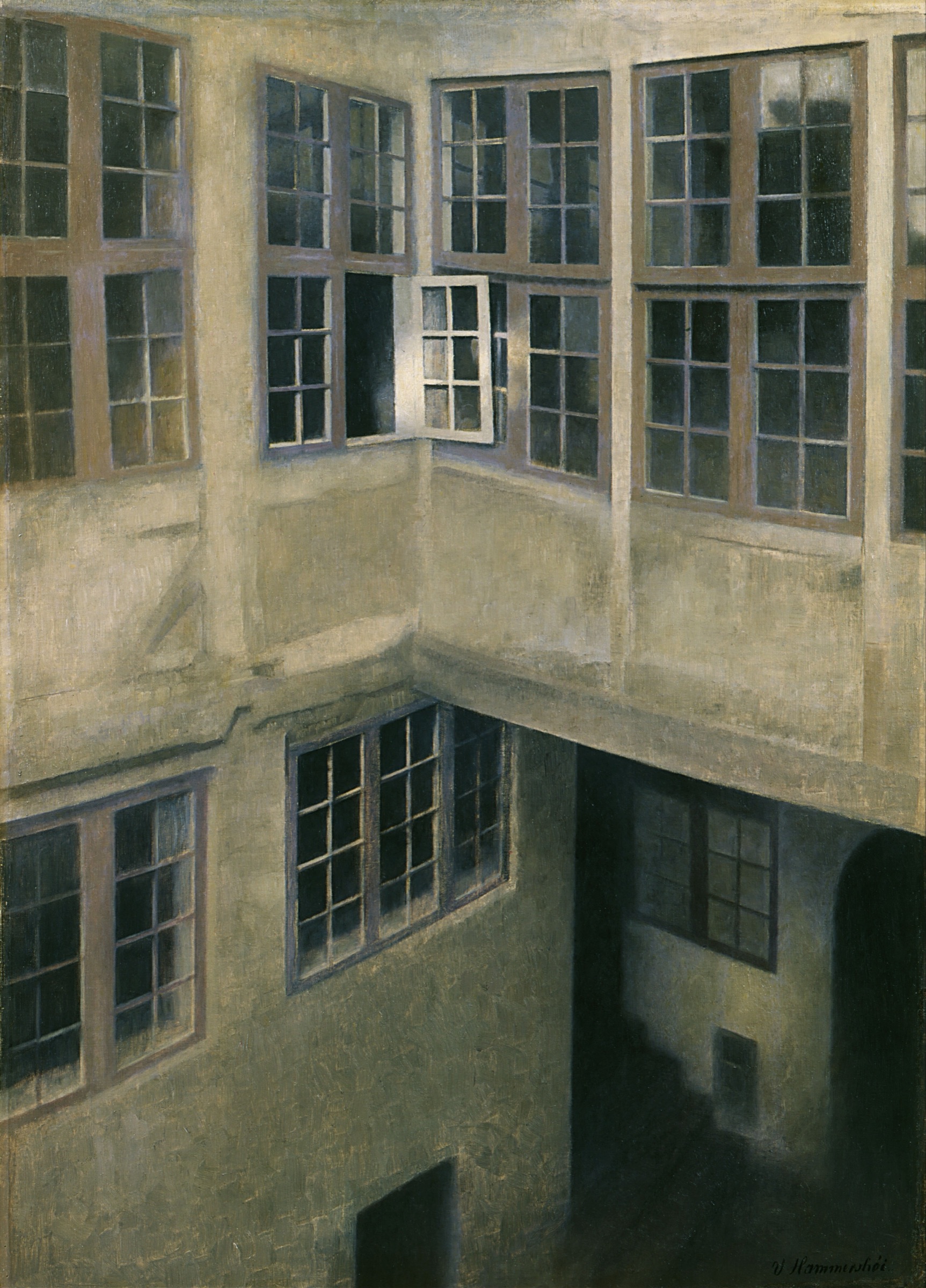
Every window is a room where somebody might be sitting.
03 · The Long Wait
A person in a depressive episode presents to a doctor describing depression, because that is what they are experiencing and that is what they came in for.
The highs, if they are moderate, do not feel like an illness from the inside. They feel like a good spell. They feel like being finally, properly well: productive, confident, sleeping less and achieving more. Nobody books an appointment to report that. So the clinician is shown one half of a pattern and treats what is in the room.
That is the mechanism behind one of the more sobering findings in psychiatry, which is the sheer length of time between a person first becoming unwell and anybody correctly naming what is happening to them.
6.7 years
The median delay between the onset of bipolar disorder and its diagnosis, pooled across 59 studies of more than 40,000 people internationally. A median of 3.5 years passes before help is sought at all.
Systematic review and meta-analysis, Acta Psychiatrica Scandinavica, 2022
The figure quoted more often in this country is longer still. On World Bipolar Day in 2024 the Royal College of Psychiatrists and Bipolar UK jointly put the average wait between first raising symptoms with a health professional and receiving an accurate diagnosis at nine and a half years.
We are printing both numbers deliberately, and we are telling you the difference between them. The nine and a half years comes from Bipolar UK's own Bipolar Commission survey of 2,458 people who already had a diagnosis, reached through Bipolar UK's channels. That is a self-selected sample, and people who took longer to be diagnosed are exactly the people most likely to join a charity and answer its survey. The 6.7 years is peer reviewed and pooled internationally. Both are worth knowing. Only one is a population estimate. Anyone quoting the larger figure at you without that caveat is not being straight with you.
What is not in dispute is the direction of the error, and it is always the same direction.
Three in five
60.9 per cent of people in the Bipolar Commission survey said they had at some earlier point been diagnosed with depression. The pattern is not random misdiagnosis. It is the reliable consequence of a condition that only sends half of itself to the appointment.
Bipolar UK, Bipolar Commission, 2021
One in six
Pooling ten studies of 3,803 primary care patients already diagnosed with depression, 17 per cent were found to have bipolar disorder that had gone unrecognised. In one English study of 233 patients on antidepressants at West Yorkshire practices, 7.3 per cent had unrecognised bipolar disorder, and in every case it was the milder bipolar II.
Daveney and colleagues, General Hospital Psychiatry; Hardoon and colleagues, English general practice
There is one more number, and it is the one that should give any reader of official statistics pause. Everything we know about how common this is rests on a screening questionnaire. That questionnaire has a sensitivity of 0.28. It identifies roughly a quarter of the people it is looking for.
The survey says so itself. NHS England publishes the limitation alongside the finding, which is the correct and honest thing to do, and it means the 890,000 on the earlier page should be read as a floor rather than a count. This is what good statistics look like: not certainty, but a number that knows what it does not know.
04 · What the Evidence Says
Nothing in this section is advice, and none of it is a promise. It is a description of where the published evidence currently points, and it is included because the alternative, which is a magazine that describes a problem and then goes quiet, is worse.
The interventions with the strongest evidence base are almost aggressively undramatic. They involve sleep, routine, keeping a record, and other people knowing what to look for.
Start with why a record matters, because it is the cheapest intervention available and the one most often skipped.
47.3% of weeks
Followed for an average of 12.8 years, patients with bipolar I disorder were symptomatically unwell in 47.3 per cent of all weeks, and changed symptom status around six times a year. In bipolar II, across 13.4 years, depressive symptoms were present in 50.3 per cent of weeks and hypomanic symptoms in 1.3 per cent.
Judd and colleagues, University of California San Diego, Archives of General Psychiatry, 2002 and 2003
Read that second pair of numbers again, because it is the whole diagnostic problem expressed as arithmetic. In bipolar II, the half that gives the condition its name is present in about one week in seventy seven. The half that gets treated as ordinary depression is present in about half of all weeks. Anyone relying on a patient to report the rarer half from memory, years after the fact, in a ten minute appointment, is asking for something close to impossible.
A mood disorder attacks the very instrument you would use to measure it. Inside an episode, the episode does not feel like weather. It feels like an accurate reading of the world. A record kept when you were level is evidence that survives that, and it is the thing clinicians most often wish a new patient had brought with them.
On treatment, the published position is clearer than the public conversation suggests. For long term management of bipolar disorder in adults, the national guideline names lithium as the first line pharmacological treatment, at recommendation 1.7.7 of guideline CG185, published in 2014 and last updated in September 2025.
The stronger finding, and the one least reflected in practice, is that medication alone is not the ceiling.
Odds ratio 0.56
Across 39 randomised trials involving 3,863 people, adding a manualised psychological therapy to medication was associated with lower rates of recurrence than medication alone. Group psychoeducation for bipolar disorder reduced relapse of any kind, with between five and seven people needing to be treated for one to benefit.
JAMA Psychiatry, 2021; Bipolar Disorders, 2015
Hazard ratio 0.69
Pooling individual data from nine randomised trials of 1,258 adults with recurrent depression in remission, those given mindfulness based cognitive therapy had a lower risk of relapse across 60 weeks. Measured only against other active treatments the effect is smaller, 0.79, and that is the honest number to hold.
Kuyken and colleagues, University of Oxford, JAMA Psychiatry, 2016
None of this is a cure and none of it is a guarantee. What the evidence describes is a set of unglamorous things that shift the odds: a record, a correct name, a guideline followed, a therapy added to a prescription rather than substituted for one, and somebody who knows the pattern well enough to notice a change before the person in it does.
05 · The Cost of Not Knowing
There is a version of this argument that appeals purely to decency, and it is true, and it does not move budgets. So here is the other one.
The people most likely to be carrying an unrecognised mood disorder in a workforce are frequently among its higher performers, because the hypomanic phase is productive and because the depressive phase stays hidden behind competence for as long as competence holds out. An organisation that cannot tell the difference between a good spell and a warning sign will read the first as talent and the second as a sudden and inexplicable decline.
The bill for that is now measured, and readers of our first issue will recognise the number.
£51 billion
The estimated annual cost of poor mental health to UK employers: £23.8 billion in presenteeism, £19.5 billion in staff turnover, and the remainder in absence. Note the order. The largest single component is not people being away. It is people being present and unwell.
Deloitte, Mental health and employers, 2024
62% of days lost
Stress, depression or anxiety accounted for 52 per cent of all work related ill health in Great Britain in 2024/25 and 62 per cent of all working days lost to it, with an estimated 964,000 workers affected and 22.1 million working days lost.
Health and Safety Executive, 2024/25 statistics, published November 2025
The return on doing something about it is commonly quoted at £4.70 for every pound spent. We are printing that figure with its own caveat attached, because the underlying evidence review contains interventions that returned a loss as well as ones that returned a great deal more. What the review does show consistently is that organisation wide measures, culture and awareness, outperformed interventions aimed only at individuals already struggling, by roughly six to one against four to one.
Which is the commercially awkward conclusion. The thing that pays is not a counselling number in a handbook. It is a workforce in which noticing is normal, and in which a manager who sees a pattern knows what to do next.

The pendulum does not stop. It is not supposed to.
06 · Still Swinging
The honest ending to this issue is not that the pendulum can be stopped. It cannot, and a publication promising otherwise would be lying to the people who most need it to be straight with them.
What can change is everything around the swing. Whether it is recognised. Whether it is named early rather than after a decade. Whether the person riding it has a record, a clinician, and two or three people who know what they are looking at. Whether the employer reads the pattern as a warning rather than a personality.
At a football ground the whistle does that work for everybody at once, which is why nobody has to think about it. Outside the ground there is no whistle and no man in the middle. There is only what other people notice, and how quickly.
That is the whole argument, and it is smaller and more ordinary than the subject deserves. Notice earlier. Name it properly. Write it down. Tell somebody who can act.
We publish this magazine because that sequence is not automatic and somebody has to keep saying it. If the pages that got your attention were the ones with the football in them, that was the intention. The stadium is the part everybody already understands. It was only ever here to measure the distance to the part they do not.
Outside the ground there is no whistle. There is only what other people notice, and how quickly.
Please talk to one of these before you do anything else. They are free, they are there through the night, and they are used to exactly this conversation.